
Take Action Now and Understand How AI for Sales Leaders Is Redefining Revenue Strategy
Learn how AI for sales leaders is transforming forecasting, deal execution, and scalable growth, helping sales teams operate with precision, speed, and confidence in competitive markets.
The rise of AI for sales leaders marks a structural shift in how sales organizations operate, plan, and scale.
In a landscape defined by longer buying journeys, data overload, and increasing pressure for predictable revenue, artificial intelligence has moved from experimental tool to strategic necessity.
Learn how artificial intelligence in medicine is redefining diagnostics, clinical efficiency, and patient safety in the United States.
Why AI for Sales Leaders Has Become a Strategic Imperative 📈
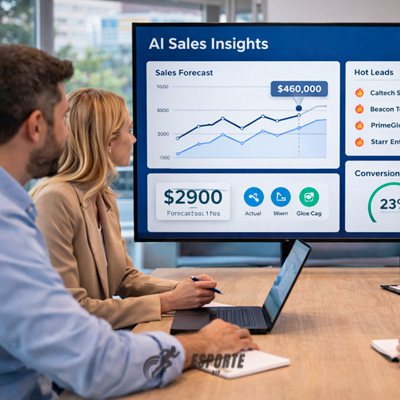
Modern sales teams generate massive volumes of data across CRMs, calls, emails, and customer interactions.
Without intelligent systems, this data becomes noise rather than insight. AI for sales leaders converts fragmented information into structured intelligence.
Artificial intelligence enables leaders to move from reactive management to proactive strategy.
Instead of reviewing performance after outcomes are locked, sales leaders can intervene earlier, identify risk signals, and guide teams with greater accuracy.
This shift is critical for organizations operating in competitive, data-rich environments where speed and precision directly affect revenue outcomes.

How AI for Sales Leaders Improves Revenue Forecasting Accuracy 🔍
Revenue forecasting has historically relied on subjective deal assessments and lagging indicators.
AI for sales leaders introduces a data-driven approach that analyzes historical patterns, deal behavior, and buyer signals in real time.
AI-powered forecasting models evaluate variables such as engagement intensity, deal velocity, stakeholder participation, and past conversion rates.
This produces probability-weighted forecasts that are significantly more reliable than manual projections.
For leadership teams, improved forecasting reduces surprises, strengthens board-level confidence, and enables better alignment between sales, finance, and operations.
Key forecasting benefits include:
- Early identification of at-risk deals
- More accurate pipeline coverage ratios
- Improved quarter-over-quarter predictability
Artificial Intelligence in Pipeline Prioritization and Deal Scoring 🎯
One of the most impactful applications of AI for sales leaders is intelligent pipeline prioritization. Not all opportunities deserve equal attention, yet many teams still rely on surface-level metrics to allocate effort.
AI-driven deal scoring evaluates multiple dimensions simultaneously, including buyer intent signals, interaction quality, timeline alignment, and historical outcomes.
This allows leaders to direct focus toward opportunities with the highest probability of closing.
Pipeline prioritization powered by AI improves win rates while reducing wasted effort on low-quality or stalled deals. Over time, this creates a more disciplined and efficient sales organization.
How Artificial Intelligence Sales Leaders Elevates Sales Team Performance 🧠
Sales leadership increasingly involves coaching, not just managing numbers. AI for sales leaders provides unprecedented visibility into individual and team performance patterns.
By analyzing calls, emails, and activity data, AI identifies strengths, weaknesses, and skill gaps at the rep level.
Leaders gain objective insights into behaviors that correlate with success, such as talk-to-listen ratios, objection handling, and follow-up timing.
This enables personalized coaching at scale, replacing generic feedback with data-backed guidance. Teams improve faster, onboarding becomes more effective, and performance consistency increases.
AI-driven performance insights support:
- Targeted coaching interventions
- Faster ramp-up for new hires
- Identification of top-performer behaviors
Artificial Intelligence Leaders Across B2B and B2C Sales Environments ⚖️
The value of AI for sales leaders varies by sales model, but its strategic importance spans both B2B and B2C contexts.
In B2B environments, AI excels at managing long sales cycles, complex buying committees, and account-based strategies.
It helps leaders track multi-stakeholder engagement, identify decision-makers, and time outreach effectively.
In B2C or high-velocity sales, AI focuses on lead routing, conversion optimization, and volume efficiency.
Predictive models ensure leads are contacted at the right moment and by the right rep. In both cases, AI enables sales leaders to scale intelligently without sacrificing quality.
Understand how an artificial intelligence leadership course equips leaders to evaluate AI investments, manage risk, and drive innovation.
Artificial Intelligence Leaders and CRM Optimization 🧩
CRMs are central to sales operations, yet many fail to deliver actionable insight. AI for sales leaders transforms CRMs from passive data repositories into intelligent decision engines.
AI-enhanced CRMs automate data entry, surface insights proactively, and highlight next-best actions. Leaders spend less time chasing reports and more time driving strategy.
This shift also improves data quality, as automation reduces manual errors and increases consistency across teams.
CRM optimization through AI leads to:
- Higher data accuracy
- Reduced administrative burden
- Faster access to actionable insights
Use Artificial Intelligence to Improve Deal Closing Rates 💰
Closing deals is where strategy meets execution. AI for sales leaders supports closing performance by analyzing conversation data, buyer objections, and engagement signals.
AI tools can detect hesitation, competitive mentions, and pricing concerns during sales calls.
Leaders can then coach reps on how to address objections more effectively or adjust deal strategy before momentum is lost.
Timing is another critical factor. AI identifies optimal moments for follow-ups, proposals, and negotiations, increasing the likelihood of successful closes.
Ethical and Strategic Considerations of Artificial Intelligence ⚠️
While powerful, AI for sales leaders must be implemented thoughtfully. Overreliance on automation can reduce human judgment, and poorly trained models may introduce bias.
Sales leaders are responsible for ensuring transparency, data privacy, and ethical use of AI.
This includes clear governance, regular model evaluation, and alignment with organizational values.
AI should support decision-making, not replace accountability. The most successful leaders use AI as a strategic partner, not a substitute for leadership.
Artificial Intelligence Driving Scalable and Sustainable Growth 🚀
Scalability is one of the strongest arguments for AI for sales leaders. As teams grow, complexity increases exponentially. AI enables standardization without rigidity.
By embedding intelligence into workflows, organizations can expand into new markets, onboard new reps faster, and maintain performance standards at scale.
AI-driven insights also support strategic planning, helping leaders allocate resources, adjust territory design, and optimize compensation models as the business evolves.
The Future Outlook of AI for Sales Leaders 🤖
The future of AI for sales leaders points toward deeper integration and greater autonomy. Emerging trends include AI sales copilots and advanced scenario modeling.
Rather than reacting to performance metrics, leaders will increasingly simulate outcomes, test strategies virtually, and guide teams with predictive intelligence.
Sales leadership is evolving from intuition-led management to insight-driven orchestration, and AI is at the center of that transformation.
FAQ ❓
- What is the main benefit of AI for sales leaders?
- It improves decision-making through data-driven insights and predictive intelligence.
- Can AI replace sales managers or leaders?
- No, AI supports leadership but does not replace human judgment or accountability.
- Is AI for sales leaders suitable for small teams?
- Yes, it helps smaller teams operate with efficiency and focus.
- How does AI improve sales forecasting?
- By analyzing patterns, behavior, and historical data more accurately than manual methods.
- What risks should sales leaders consider when using AI?
- Data privacy, bias, and overreliance on automation are key considerations.
