
Toyota Tacoma trims 2026 for comparing transmission, towing, tires and maintenance costs
Toyota Tacoma trims 2026 are usually compared by equipment lists, yet the difference that shows up in the bank account comes from somewhere else entirely.
The lineup shares one engine family, so scheduled maintenance follows a similar pattern across builds.
What separates them in daily ownership is the transmission choice, the tire specification and the amount of exposed hardware that a minor parking incident can damage.
The sections below organize that comparison, showing which items actually vary between configurations and which figures need to be confirmed on the specific truck before any deal is signed.
What separates the Toyota Tacoma trims 2026 in service? 🔧
Across the Toyota Tacoma trims 2026, the powertrain is a 2.4-liter turbocharged four-cylinder from the i-FORCE family.
The entry build is rated at 270 horsepower at 5,400 rpm with 310 pound-feet of torque and pairs with a manual transmission, while the SR5, TRD Sport, TRD Off-Road and Limited builds are rated at 278 horsepower at 6,000 rpm with 317 pound-feet and use an automatic.
That split matters more in the shop than the ten-horsepower gap suggests. A manual gearbox brings a clutch into the picture, which is not a scheduled maintenance item and whose life depends almost entirely on driving habits.
An automatic removes that variable but adds a fluid with its own specification and replacement interval defined in the owner’s manual.
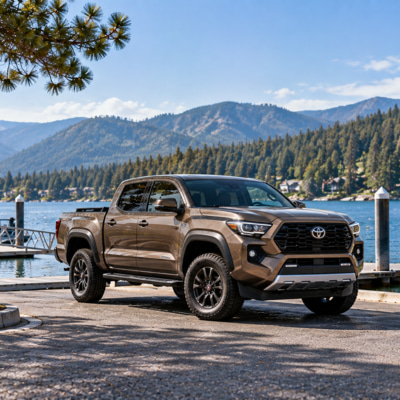
How to compare builds by recurring expense ✅
The comparison becomes objective once you isolate costs that repeat every year. For each build under consideration, confirm:
- the exact tire size fitted to the truck being quoted;
- replacement pricing for a full set in that size;
- local availability of that size outside major metro areas;
- the transmission fluid specification and its replacement interval;
- the number of sensors mounted in the bumpers;
- fixed pricing for each scheduled service visit.
Clutch wear on manual builds ⚙️
Holding the truck on an incline with the clutch instead of the parking brake is what shortens its life fastest.
The habit costs nothing to change and the accumulated difference over several years is substantial, particularly for a truck used in stop-and-go traffic.
Towing within published limits 🚚
All builds carry a 6,400-pound towing rating. Staying inside that figure protects the transmission, the cooling system and the brakes. E
xceeding it accelerates wear on all three and can complicate a warranty claim if a failure follows.
Planning the purchase and the budget 💳
Ownership cost includes insurance, registration and tires alongside the payment itself. Buyers preparing the financing side can review how an auto loan pre-approval with a cosigner strengthens an application before committing to a monthly figure.
The figures that separate Toyota Tacoma trims 2026 📊
When projecting ownership cost across the Toyota Tacoma trims 2026, the deciding data points are transmission type, tire specification and towing rating.
The first defines the most specific service in the plan, the second concentrates the largest recurring expense, and the third sets the operating limit that protects the driveline.
A second consideration is worth stating plainly. Moving up the lineup does not deliver meaningfully more capability, since the towing rating holds steady across builds.
What it delivers is equipment, appearance and off-road hardware, each carrying its own maintenance and repair implications over time.
Trim and powertrain reference 🧾
| Build | Output | Transmission | Towing rating |
| SR | 270 horsepower at 5,400 rpm and 310 pound-feet | Manual | 6,400 pounds |
| SR5 | 278 horsepower at 6,000 rpm and 317 pound-feet | Automatic | 6,400 pounds |
| TRD Sport | 278 horsepower at 6,000 rpm and 317 pound-feet | Automatic | 6,400 pounds |
| TRD Off-Road | 278 horsepower at 6,000 rpm and 317 pound-feet | Automatic | 6,400 pounds |
| Limited | 278 horsepower at 6,000 rpm and 317 pound-feet | Automatic | 6,400 pounds |
The table shows a lineup with one engine family and one towing rating, which keeps the scheduled maintenance plan consistent across builds.
The practical differences concentrate in transmission choice and in the hardware each configuration carries.
Figures reflect the United States lineup as of the verification date, and pricing is excluded because it varies by dealer and period.

Risks and points of attention ⚠️
Three oversights create avoidable expense. Confirming tire size on the showroom truck rather than on the one being purchased. Skipping the transmission fluid interval because it does not appear in the first few services.
And assuming that off-road hardware eliminates the need for appropriate tires, when tread compound remains the single largest factor in traction.
Buyers who also track weekend schedules can plan around published listings such as where to watch a major all-star soccer event, while readers exploring analysis tools may find value in a guide to artificial intelligence applied to qualitative research.
The right build is the one that fits the tires 🧭
Choosing among Toyota Tacoma trims 2026 gets simpler once you add tire replacement cost and local parts availability to the sticker price.
With those two figures confirmed, the gap between one configuration and another stops being a matter of appearance and becomes a verifiable budgeting decision for the years ahead.
FAQ ❓
- Does the higher-output engine tow more?
- No. The published towing rating holds across builds, so the difference is in output figures rather than capability.
- Is the clutch covered by the factory warranty?
- Clutches are generally treated as wear items with separate terms, so confirm the conditions in writing.
- Where can official lineup information be confirmed?
- On the official Toyota Tacoma page, which publishes configuration details by build.
- Does the automatic transmission need fluid service?
- It uses a fluid with its own specification and interval, both defined in the owner’s manual for the vehicle.
- Do larger wheels increase running costs?
- They typically raise tire replacement pricing and firm up the ride without changing scheduled service costs.
